Showing posts with label Austria. Show all posts

Wednesday, November 21, 2007

Chapter One

A hut up on the Riesachsee, a high mountain lake where Aloisia went each summer to live in a small hut and take care of the cattle.


Chapter One: The Sennerin

Aloisia Knaus was born in the little village of Birnberg, not far from the town of Schladming, in Steiermark, Austria, on July 2, 1856. “Steiermark is one of Austria’s crown jewels,” writes my mother Beverly, “with towering mountains, high alpine lakes, forests, and meadows abloom with wildflowers in the summer. When I first visited there in 1951, I realized that what I saw was what I imagined as I read the book Heidi as a child.”


A map of Steiermark, Austria, showing its general location. Aloisia was born near the town of Schladming, on far left of pink part of map.


“Grandmother didn’t tell me much about her childhood and life in Austria and most of what I know I remember hearing from my father. She did have several brothers, the youngest of which I was able to visit in 1951.”


The seal of the province of Steiermark, Austria

“Indeed, Aloisia as a child and young woman had experiences similar to those of Heidi, who lived with her grandfather in a chalet on an ‘Alm’ in the Alps of Switzerland. As a young woman, Aloisia was a ‘Sennerin’—a person who lived during the summer on the high mountain pasture, caring for the animals, milking them and turning the milk into butter and cheese. Periodically, one of her brothers would make the trek from Birnberg to the Alm, bringing supplies for her use and carrying the dairy products down to Schladming to the market.”


“When I was in Austria as a student in 1951-1952,” Beverly remembers, “my father came to visit the Old Country and we were able to visit the Alm in the mountains and indeed, located the very hut where she lived, summers, as a girl. Imagine a cup-shaped area surrounded by mountain peaks and carpeted in lush grass splattered with flowers. In the bottom of the cup is a small lake and scattered around the area are several other similar huts owned by other animal keepers. And Johanna, Grandmother’s niece with whom she kept in touch by letter after her migration to the United States, was our guide for the visit to the Alm and its lake, the Riesachsee. Although she was in her seventies at the time, she could still climb the steep mountain path to the Alm. She was able to help us find the very hut which had once belonged to the Knaus family and we were even invited in by the occupant and shown around. What I remember is a cozy little cabin on a hill slope, with the animals sheltered in the lower part dug into the hillside. One room on the main floor was the kitchen, sleeping and eating room, and another space next to it was another ‘kitchen’ with a bigger stove and equipment for making the butter and cheese.”


A teenage girl wears the traditional dirndl of Steiermark, Austria. As a teenager, Aloisia would have worn this functional outfit.


A modern photo of the Riesachsee, where Aloisia spent her summers as a semmerin. Note the small wooden huts around the edge of the lake.


“When the animals, probably cattle, were driven from Birnberg up to the Alm Aloisia carried a beehive on her back.


In addition to watching the cattle, Aloisia tended the beehives and harvested the honey. She carried the beehive up to the Alm on her back each summer.

“Many years later,” remembers Beverly, “we hiked up to the Riesachsee again. It had changed considerably from the way it was in 1951, with a restaurant and ‘Jausenstation’ where one could buy drinks and spend a pleasant sunny summer afternoon. At that time, one still had to walk up the mountain trail to get there.”


Modern hikers enjoy the peaceful scenery at the Riesachsee


A contemporary photo of the town of Schladming, Austria

“As a young woman, Aloisia probably worked in one of the shops in Schladming. She sang in the choir of the Protestant Church—the ‘evangelische Kirche’—in Schladming, still in use today.

The Protestant Lutheran Church in Schladming that Aloisia attended


“Austria is a Roman Catholic country, but this part of Steiermark has a considerable number of Protestant churches. I believe the reason for this is that the difficult mountain terrain kept this area relatively isolated during the Counter-Reformation, thus blunting its thoroughness,” writes Beverly.

Part One: Introduction


Aloisia Knaus Schupfer
Her Story

Dedicated to My Mom, Beverly Schupfer Morris


Introduction

A human life is incredibly short, and like the wisp of smoke that curls into the air only to disappear without a trace, so too must we all. In the short time allotted us on this earth, many of us leave little or no permanent mark. None, at least, that will outlast us more than the memories of those who knew us. Our main legacy, in most cases, is our children and grandchildren. Some individuals live such exemplary lives, however, that they radically alter the posterity of their families forever. They are people of great courage, character, and strength, about whom stories are told long after they are gone.


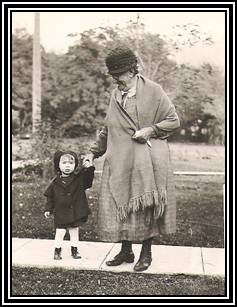
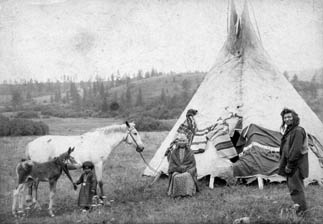
One such person is my great-grandmother, Aloisia Knaus Schupfer. From the time I was little, I heard stories about her, the young Semmerin who had followed the cows high up to an alpine lake every summer and lived alone in a wooden hut, living an existence right out of the pages of Heidi. It was family legend how she had agreed to marry a distant cousin and come to America, perhaps seeing she had no real prospects of marriage or children in Austria, and how she ended up a farm wife in the Idaho panhandle, barely able to speak English, trading her farm goods to the Nez Perce Indians for fish. Or of how her alcoholic husband had abandoned her, leaving her to raise three children alone. Despite the hardships of life, Aloisia Schupfer lived a life of kindness, service and love of family. My grandfather, Herman Schupfer, her second son, could speak only with kindness and affection about his mother. She had been the rock in the family for as long as he could remember. My mother, Beverly, her granddaughter, remembers her as a kind old woman who lived alone and spoke with a thick German accent. Of course, I don’t remember her at all. She died many years before I was born. But through the stories of my grandfather, his brother Otto, and my mother, I feel like I know her.


Several years ago, I realized that my own parents were older, and that eventually they, too, would be departing this life. I had always been attached to my parents, my mother particularly, and this new realization was deeply disturbing. In addition, I had spent quite a few years beginning in 2000 tracing down and recording the stories of the airmen who flew dangerous missions over Europe in World War Two, trying to find the stories that these men knew before they flew their final missions. This got me thinking about my own family. Every family has the material for a dozen great stories. Here I was preserving the stories of airmen and hadn’t really taken the time to find out or preserve the stories of my own family. If I didn’t do it, then future generations of descendants might never know about their ancestors. My father, Robert, also a writer, put together a brilliant story of the Morris family a few years back, but other than my grandfather Herman, nobody had done much with my mother’s side of the family.

I decided to write the story of my great-grandmother, because she is one of the most fascinating people I’ve heard of. A deeply sympathetic character, her life was never easy and she knew more than her share of separation and heartbreak, but she retained her basic goodness and loving demeanor right to the end. A woman tied to the old country, she continued to speak German with her children and had many German-speaking friends in an area settled by Austrian and German immigrants. She read a German Bible and subscribed to German newspapers. Her three children were thoroughly Americanized, without the hint of an accent, and yet they could launch into the archaic provincial German dialect spoken in the high Alps of Steiermark with perfect ease.


To write this history, I have relied on two sources. My main source is my mother Beverly, who knew Aloisia and has many memories of her, though all are through the eyes of a young girl. My other source is my late grandfather, Herman Christian Schupfer, who passed away in 1975. My grandpa was a history buff and instilled a love of history in me. Though he only had an eighth grade education (he’d had to quit school and work on the farm after his father left), he was a brilliant man who wrote three privately published books of history about the Latah County area. I spent many hours listening to his stories (he loved to talk) and looking through his ‘museum’ that he’d built in his basement. The most important thing my grandpa gave me was my faith in God. He was a religious man, and had gotten this strong faith from his mother, so one might even say that the gift she gave to him, she also gave to me.


Someday, when I have more time, I hope to write a novel about my great-grandmother. For now, a brief history will have to suffice. The important thing is to record the story, before it’s too late.