Showing posts with label homestead. Show all posts

Thursday, November 22, 2007

Chapter Three: On the Homestead

The Schupfer homestead above Juliaetta, Idaho, circa 1907. Mathias built the house himself. It's still there.


“The settling down on the homestead was the beginning of quite a chore,” writes Herman. “At this time it had on it a fruit bearing orchard, some of the ground under cultivation, a house and other buildings on it and with money they got from the sale of the property on Potlatch Ridge they bought some cattle, pigs, chickens and whatever was necessary to make a living on the homestead.”


Aloisia feeds the chickens in the farmyard of the Schupfer homestead, around 1907. She traded farm goods to the Nez Perce Indians for fish and other items not available on the farm.


“Three children were born. Otto in 1891, Herman in 1892 and Ida in 1896. Times got hard during that time—the 1893 depression, hardly any demand for farm products, some wheat burned for fuel as there was no market for it. A little income was derived from the local sale of eggs (for trade in stores) and a few other farm products. Money was scarce. Some money was derived from the sale of fruit (mostly apples) to the Indians. The Indian (Nez Perce) women would usually come on Sunday afternoon and buy fruit and would stay and visit with our mother. They spoke a different language but mother said they always got along fine and had a good time. Mother enjoyed having them come.”


I can’t help but wonder what the Austrian girl thought when she first encountered the Nez Perce Indians at her farm. It speaks highly of her tolerant and kind nature that she enjoyed them and felt no sense of fear or superiority.


Herman continues, “As the reservation was only a few miles away mother got acquainted with quite a few and had dealings with them and found that they were very honest people, and some time they would get in debt for some time but they always paid as soon as they had some money.”
Nez Perce camp at Spalding, about fifteen miles from Juliaetta, 1898.


“Mother said that one time an Indian family had owed them for a long time but the Indian man would come to the house and tell them that he did not have any money yet but would pay as soon as he could. He stopped in a number of times to tell them and on one call he motioned for mother to follow him. She was kind of scared but went with him and he had a large salmon hanging on the wall of a building which he explained was for waiting so long but that he still did not have any money. She had a hard time telling him that was enough for what he owed and when he understood he was a very happy Indian and thanked her very much. Our folks always spoke very highly of the Indians.”

A Nez Perce woman from the reservation near the homestead. She is wearing her finery and has a beautiful beaded purse.

This tolerance for other people was passed from Mathias and Aloisia to their three children. Though my grandpa would often use racist expressions, they were more sayings that were in common usage at the time and I never saw him meet anyone, of any color or religion, that he did not hit it off with right away. Everyone was his friend. This gregariousness and tolerance for others was passed on to his own children. My mother Beverly is the same way. She loves interacting with people of other nations and beliefs, and she and my father have passed that on to their children. We, in turn, have taught our kids that God created all men equal and that to think less of anyone is simply wrong. My own saying is ‘Everyone is my equal, and no one is my better’.

Wednesday, November 21, 2007

Chapter Two: Great-Grandfather Mathias Schupfer

Directions: Read this blog from the bottom up for correct order.


Chapter Two: Mathias

When Aloisia was in her mid-thirties—an old maid—she was asked by Matthias Schupfer, from the nearby village of Gröbming, to marry him and go with him to the new world. Matthias had already lived in the United States for some years.

As my mother tells it, “the story was that he was ready to marry and start a family. He went back to the old country to find a wife. He had one in mind, but she turned him down. So grandmother was his second choice. I wonder whether she jumped at the chance to go out in the world or whether it was a hard decision for her, as she surely knew she would probably never see her family in Austria again—or her beloved mountains.”

Aloisia was not an attractive woman. She had dark, craggy features, bushy eyebrows which have been a family trait in our family ever since, large manly hands, and an oversized nose. She was of a sturdy build and tended towards plumpness. Nobody in the family knows for sure why she had not been married before Mathias showed up, but it is possible that her physical unattractiveness was a factor. This is the earliest photograph we have of Aloisia, taken around 1894, when she was around forty years old. Matthias is holding my grandfather Herman on his lap. Herman's brother Otto is standing between them.

The Schupfer family tree has been traced back to early patriarch Georg Schupfer, who was born around 1750. His son, Josef, was born at Untertal #30 in 1790 and died in 1850. His son, Mathias Schupfer, was born in Birnberg #15 (the same town the Knaus family was from) in 1812 and died in 1885. This Mathias was my great-grandfather Mathias’s father.

My great-grandfather Mathias Schupfer is an enigmatic character who doesn’t come out too well in family stories. Though a very hard worker and a skilled carpenter, he had a terrible drinking problem. In fact, my grandfather was so upset by his father’s drinking that he refused to drink a drop of liquor in his whole life. Mathias brought his new bride to a strange land, fathered three children, and then, as soon as they were old enough to manage the farm without him, he abandoned the family, never to be seen again. I do not remember my grandpa ever saying anything much about him, other than that he’d left them and that he was an alcoholic. My grandfather was also very sad that because Mathias had abandoned the family, Herman had to quit school after eighth grade to run the farm with his older brother Otto. Herman was such a smart man that it was a shame that he never was able to go to high school or college. However, he became a successful businessman despite his lack of formal schooling.

My grandfather Herman writes in his family history: “My father Mathias Schupfer was born March 16, 1843 in Winkl, Gröbming, Steiermark, Austria. He came to America in the 1870’s on a wind jammer (sail boat) as a carpenter. He worked his way across the ocean to earn his passage. The only big job he had to do on the voyage was to build a coffin for a deceased passenger.”

A windjammer from the time period.

“It took three weeks to cross the Atlantic from Hamburg, Germany to New York, New York. He went to Pocahontas, Missouri where he had a half-brother who had emigrated there previously. His name was Joseph Ladreiter.”

“Father did carpenter work there and later went to California, doing carpenter work around San Francisco. A brother, Rupert, followed him from Austria and they decided to find some land to homestead. They came north to Portland, Oregon, father doing carpenter work while Rupert looked for a location. Rupert came to Lewiston, Idaho in 1877 by way of Yakima, Washington. He would hire an Indian with an extra saddle horse every time he wanted to go farther. He met General Howard’s army in Umatilla, they going down, he coming up.”

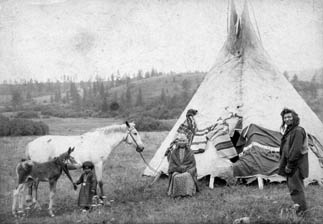
General O.O. Howard, who’d lost an arm in the American Civil War and won the Medal of Honor, had been charged with moving the Nez Perce tribe from their homeland in Oregon to a reservation in Idaho. Nez Perce Indians near Spalding, Idaho in the 1890s. Aloisia knew many and traded with them for goods.


Herman continues the story: “After arriving in Lewiston father met him later and they spent some time looking around Anatone, Washington, then back to Lewiston and father doing carpenter work around Genesee (Idaho).”

“Rupert was told at Lewiston that there were good prospects that a railroad would be built down the Big Potlatch Creek so he hired a saddle horse and rode through Genesee and down over Fix Ridge to the neighborhood of the Big and Middle Potlatch Creek junction. Here he found good water and timber. Here they decided to homestead. Rupert filed on 160 acres, part of what is now Juliaetta and father filed on 160 acres farther north one fourth of a mile in 1879.”

My mom adds, “Grandfather Schupfer bought land on Potlatch Ridge, homesteaded, and later moved to Juliaetta.”

“They each built a cabin and were required to sleep on their land a certain number of nights each year for five years and make certain improvements. Rupert did most of the improving while father did carpenter work as money was needed.”

“In 1884 they were issued deeds to their homesteads, these were signed by President Chester A. Arthur. Father kept on making improvements on his own place and also for others. Rupert platted part of his homestead as a townsite, this was at that time named Schupfer.” The name was later changed to Juliaetta. The postmaster of Schupfer, Idaho proposed changing the name to honor his two daughters, Julia and Etta. Thus, the Schupfer name lost its chance to grace an American town.

“Our father Matthias made a trip back to Austria in 1887 and in 1888 Aloisia Knaus of Schladming, Austria came back with him and they were married in New York, New York. From there they went by boat to Norwalk, Virginia (possibly Norfolk) then by train to Palouse Junction where they were met by his brother Rupert, with a team and buggy or hack (spring wagon).”

In a photograph taken about 1900 on Mathias’s front porch near Juliaetta, the three Schupfer brothers pose with home-made wine from their vineyards. Left to right, they are Rupert, Mathias, and Florian.

The letter above was written on May 28, 1886 in Juliaetta, Idaho by Matthias’s brother Rupert. Written in old German script, my mom and I had a friend of hers from Germany translate it for us. It tells of planting many trees on Rupert’s land. Rupert planted over 6,000 trees on his land, both sugar maples and catalpas. Rupert also writes that he has just gotten married two days previously to Constancia Altmiller. Rupert writes: “Altmiller was very much against it because he wanted his daughter to marry only a Catholic. But our relationship had developed so far that marriage had become an urgent matter.”